
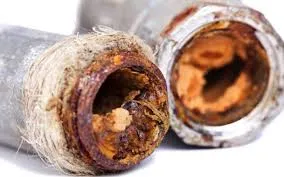
In the world of New York City real estate, “pre-war” is a badge of honor. It signals high ceilings, thick walls, and architectural character. But as we move into 2026, those same historic buildings are facing a chemical reckoning. While the city has made massive strides in replacing lead service lines, a secondary culprit is increasingly responsible for failed tap water tests: aging galvanized steel plumbing.
For decades, galvanized pipes were the industry standard, installed in thousands of multi-unit buildings across the five boroughs as a “safer” alternative to pure lead. Today, these pipes have reached the end of their functional lifespan, acting as a hidden reservoir for heavy metals and a primary driver of water quality failures in Manhattan, Brooklyn, and the Bronx.
The Irony of the “Safe” Alternative
Galvanized pipes are steel pipes that have been dipped in a protective zinc coating to prevent rust. In the mid-20th century, they were seen as a modern marvel. However, the chemistry of the era had a significant flaw: the zinc used for galvanizing was often “industrial grade,” meaning it contained impurities—most notably lead and cadmium.
As we’ve observed in recent , the problem with galvanized plumbing is twofold. First, as the zinc coating inevitably corrodes over decades of exposure to NYC’s slightly acidic water, it releases those original lead impurities directly into the stream. Second, the rusted interior of the pipe becomes porous and “sticky,” acting as a magnet for lead particles traveling from the street-side service line. Even if a building replaces its main connection to the city, the “memory” of that lead remains trapped in the scales of the internal galvanized risers.
The “Brown Water” Warning
One of the most common complaints in older NYC apartments is the appearance of “brown” or “rusty” water, especially after a period of stagnation or during a city water main repair. This is a classic symptom of galvanized pipe failure.
When the interior of a galvanized pipe corrodes, it develops “tubercles”—small, crusty mounds of iron oxide. These mounds do more than just discolor your water; they:
- Restrict Flow: Gradually narrowing the pipe’s diameter, leading to the low water pressure common in older walk-ups.
- Harbor Biofilms: The rough, rusted surface is the perfect breeding ground for bacteria.
- Trap Particulates: Acting as a filter that captures and then sporadically releases concentrated “slugs” of lead and iron.
On our , we frequently highlight that “rusty water” is not just an aesthetic nuisance; it is a signal that your plumbing is physically disintegrating from the inside out.
Why 2026 is a Turning Point for NYC Plumbing
The urgency around galvanized pipes has reached a fever pitch this year due to the 2024 Lead and Copper Rule Improvements (LCRI). Under these new federal mandates, “Galvanized Requiring Replacement” (GRR) lines are now officially categorized alongside lead service lines.
The NYC Department of Environmental Protection (DEP) has expanded its and replacement programs, acknowledging that a “lead-free” city is impossible without addressing galvanized infrastructure. In 2026, many property owners are finding that they no longer have the luxury of “patching” old systems. If a galvanized line was ever downstream of a lead line, it is now legally and scientifically considered a lead hazard.
The Multi-Unit Dilemma: Vertical Failures
In NYC’s multi-family buildings, the complexity of the plumbing often masks the source of a failure. A “First Draw” sample taken from a kitchen tap might fail for lead, while a sample from the basement meter passes. This confirms that the contamination is occurring within the building’s vertical infrastructure.
Because galvanized pipes were used so extensively for internal risers and branch lines, a single apartment might have a “patchwork” of plumbing—new copper in the renovated kitchen, but 80-year-old galvanized steel hidden behind the bathroom tile. This “mixed plumbing” environment can actually accelerate corrosion through a process called galvanic action, where the contact between different metals causes the older pipe to corrode even faster.
For more information on how these different pipe materials interact, visit our .
Solutions: Beyond the Quick Fix
If you live in a building with galvanized plumbing, the path to safe water requires a strategic approach.
- Comprehensive Testing: Don’t just test the kitchen sink. You need to understand if the failure is building-wide or unit-specific.
- Strategic Flushing: While not a permanent solution, running your water for 2-3 minutes after a period of stagnation can significantly lower lead and iron levels.
- Point-of-Use (POU) Filtration: Because galvanized pipes leach metals just inches from your tap, a whole-building filter in the basement isn’t enough. An NSF-53 certified filter at the kitchen sink is the only way to catch “endpoint” contamination.
- Complete Abatement: The gold standard is a full repipe with modern materials like copper or PEX. Many NYC buildings are now utilizing the DEP’s free replacement programs for eligible properties to transition away from galvanized steel. You can find more on these in our recent guide.
Conclusion: The End of the Galvanized Era
The era of galvanized steel in New York City is coming to a close. What was once a solution is now one of the primary obstacles to clean water in the five boroughs. For homeowners, Co-op boards, and renters alike, identifying and addressing these “rusty” relics is no longer a matter of home improvement—it is a matter of public health.
By moving beyond the “pre-war charm” and looking at the chemistry behind the walls, New Yorkers can finally achieve the water quality that the city’s world-class reservoirs intend to provide.
If you suspect your building has galvanized plumbing or if you’ve received a failed water test, please today. We can help you navigate the latest NYC points for testing kits and replacement programs.