
From Newport’s luxury high-rises to Bergen-Lafayette’s historic walk-ups, Jersey City residents often assume that water quality remains consistent throughout their buildings. However, complex plumbing systems, building height, storage tanks, and water circulation patterns can create differences in water conditions between individual units. Recent laboratory samples have revealed noticeable variations in chlorine residuals between lower and upper floors, highlighting how water chemistry can change as it travels through a property’s internal infrastructure.
For residents concerned about potential differences in tap water quality, lead water testing near me in Jersey City can help identify tap-specific contamination concerns and provide insight into how building plumbing may influence drinking water conditions. Testing at individual fixtures allows homeowners and property managers to better understand whether issues are isolated to specific locations or affecting the wider building system.
Maintaining consistent water quality in large residential buildings requires more than relying only on municipal treatment standards. Factors such as pipe conditions, water age, storage systems, and internal plumbing design can all influence the final quality of water reaching residents.
As Jersey City continues to grow with more high-density residential developments, proactive water testing is becoming an important part of protecting residents and maintaining reliable building water systems. Detailed laboratory analysis helps identify hidden concerns and supports informed decisions about maintenance, filtration, and long-term water safety.
What is Chlorine Residual, and Why Does it Vary?
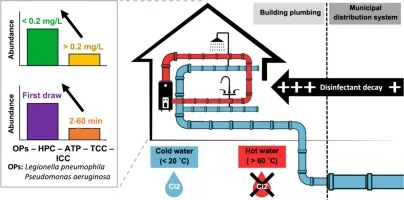
Chlorine residual is the small amount of chlorine that remains in the water after the initial disinfection process. Its job is to act as a “security guard,” traveling through the miles of city mains and building pipes to prevent the growth of bacteria and viruses.
However, chlorine is a volatile chemical. It “decays” over time as it reacts with organic matter, pipe materials, and even the air. In a complex apartment ecosystem, several factors cause these levels to fluctuate:
- Water Age: This is the primary driver of low residuals. In massive high-rise buildings, water can sit in the risers or rooftop storage tanks for days during periods of low occupancy. The longer it sits, the more the chlorine dissipates.
- Temperature Spikes: Jersey City’s summer humidity doesn’t just affect your walk to the PATH train; it affects your pipes. Warm water causes chlorine to break down much faster. Samples taken from “sun-facing” apartment stacks often show lower residuals than those in shaded areas of the building.
- Pipe Material Interaction: Older buildings with unlined iron pipes exert a high “chlorine demand.” The chlorine is “used up” fighting the rust and scale inside the pipes before it ever reaches your faucet.
The Findings: High vs. Low Extremes
Recent into Jersey City multi-unit systems have shown two distinct—and equally concerning—extremes in chlorine levels:
1. The “Bleach” Burst (High Residuals)
Residents on lower floors or those living closest to the city’s booster stations often report a strong, bleach-like smell. These units receive water that has had very little time to “age.” While high chlorine is effective at killing pathogens, it can lead to significant skin and eye irritation in the shower and may increase the presence of Disinfection Byproducts (DBPs) like Trihalomethanes.
2. The “Stagnant” Dip (Low Residuals)
Conversely, apartments at the ends of long hallways or on the highest floors often show residuals near zero. As highlighted in current , water with zero residual is vulnerable to “regrowth.” This is where biofilms—slimy layers of bacteria—begin to colonize the interior of the plumbing. This can lead to musty odors and, in some cases, the presence of opportunistic pathogens like Legionella.
Why This Matters for Apartment Dwellers
For someone living in a Jersey City rental or condo, variable chlorine isn’t just an “aesthetic” issue; it has real . When residuals are too high, the water can strip natural oils from your hair and skin. When they are too low, the water loses its protective barrier against localized contamination.
Furthermore, these fluctuations are often a precursor to larger issues. We frequently discuss on our how a sudden drop in chlorine often indicates a “break” or a “leak” somewhere in the system that is introducing new organic material into the water stream.
Navigating the Disinfection Gap
If you live in a multi-unit building, you cannot control the building’s main plumbing, but you can control your “Point of Use.” Here is how to handle variable residuals:
- The “Morning Flush”: If your water smells like “nothing” or has a musty odor, run your tap for 2 minutes. This clears the stagnant water from your unit’s internal lines and brings in “fresh” chlorinated water from the building’s riser.
- Check the Aerators: Unscrew the screens on your faucets. If you see black or slimy buildup, it’s a sign of low chlorine residuals allowing a biofilm to grow in your fixture.
- Carbon Filtration: A high-quality carbon filter is the best way to manage high chlorine levels. It will strip the bleach taste and smell just before you drink it, while allowing the chlorine to protect the water during its journey through the building.
Conclusion: Don’t Guess, Test
Jersey City is a city of incredible growth, but our water infrastructure is a patchwork of the old and the new. Variable chlorine residuals are a natural byproduct of this complexity. Whether you are dealing with the “over-chlorinated” water of a ground-floor unit or the “depleted” water of a penthouse, the key is awareness.
If you’ve noticed a change in the smell of your water or if you’re experiencing unexplained skin dryness, it might be time to see where your apartment falls on the residual spectrum.
If you are concerned about your building’s water quality or need help interpreting a recent lab result, please today. We can help you understand the specific relevant to your neighborhood and find a filtration solution that works for your home.
Would you like me to help you find a certified water testing professional in Hudson County who specializes in “disinfection byproduct” and residual analysis for high-rise buildings?